
The year 2025 is a phase marked by proud breakthroughs for the University of Economics Ho Chi Minh City (UEH) on its journey of conducting research for the public good. From a strong spirit of academic commitment to research outputs with high practical value, UEH’s faculty members and scientists have continuously innovated, disseminated knowledge, and generated positive and sustainable impacts on society. Through these efforts, UEH has further affirmed its academic reputation and pioneering position both nationally and internationally.
Outstanding Research Achievements in 2025
International publications and research projects: growth in quantity, strength in quality, and alignment with the SDGs and contemporary issues
In 2025, UEH recorded a series of remarkable scientific research achievements. Across the University, 573 international articles were published in prestigious academic databases (ISI/Scopus/ABDC), reaching an average of 1.14 publications per faculty member - an impressive figure that reflects the strong publication capacity of UEH’s academic staff.
UEH’s international academic reputation and research quality were further evidenced by the Journal of Asian Business and Economic Studies (JABES) continuing to be ranked in the Scopus Q1 category for the third consecutive year. Notably, 84.6% of UEH’s Scopus-indexed publications in 2025 were published in Q1 and Q2 journals.
In addition to international publications, UEH implemented and completed 129 research projects at various levels in 2025, including numerous key national-level and ministerial-level projects. These studies focused on addressing contemporary economic and social issues closely aligned with the Sustainable Development Goals (SDGs).
Scientific Conferences 2025: Connecting Scholars, Spreading Interdisciplinary Knowledge
In 2025, UEH organized and co-organized numerous national and international scientific conferences across a wide range of fields, from economics and management to technology and design.
Most notably, UEH hosted the IASC–ARS 2025 International Conference on Statistics and Data Science, featuring 44 parallel sessions and 169 research papers presented. The conference covered topics ranging from probability and statistical theory to applications of AI and Machine Learning in finance and Big Data. The participation of leading professors from Asia, Europe, and the United States, together with lively interactive discussions, offered diverse perspectives and fostered intellectual exchange between fundamental research and innovation-driven advances in data science.
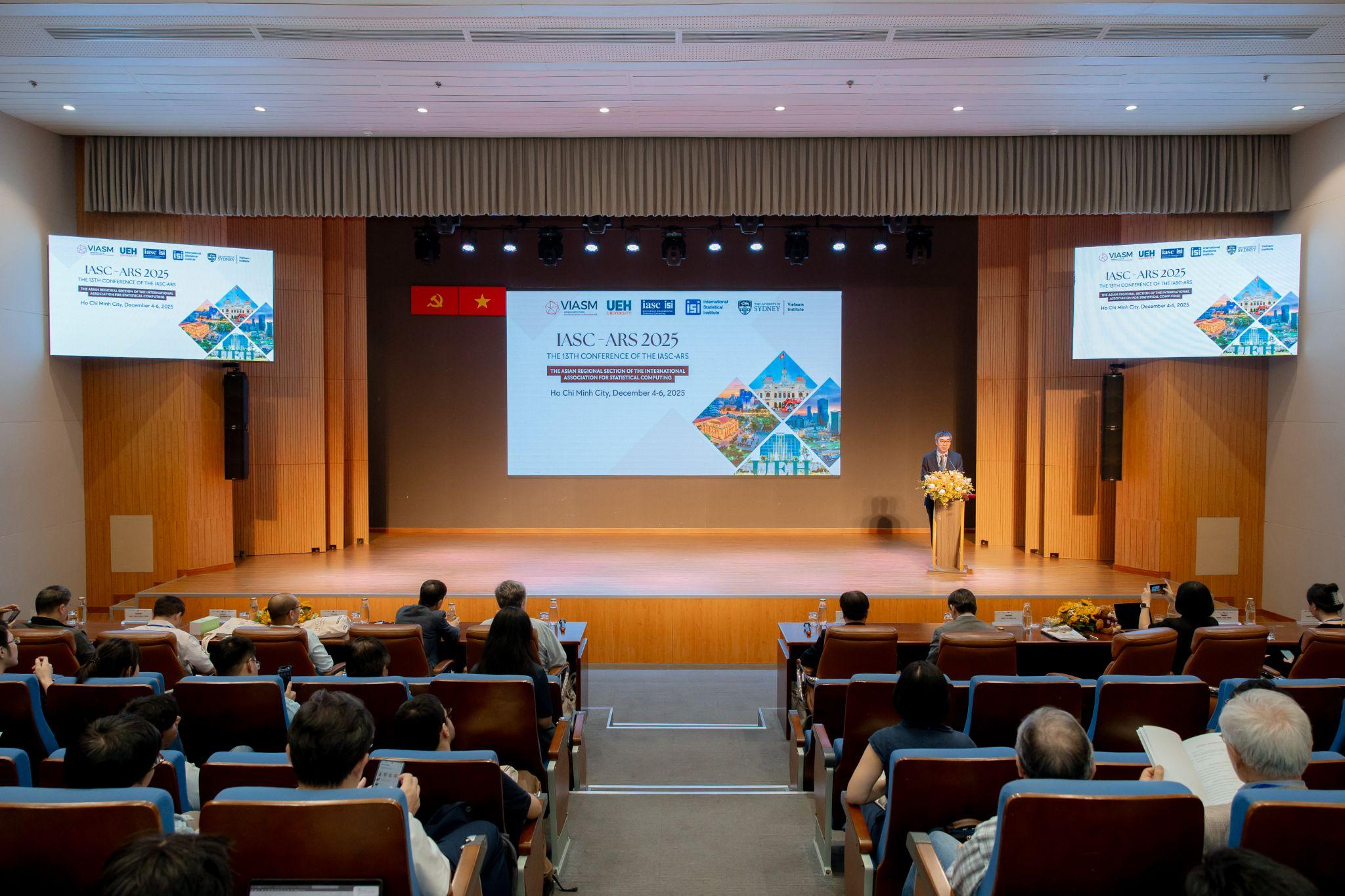
IASC–ARS 2025 International Conference
In addition, UEH strengthened the organization of timely, practice-oriented conferences closely linked to Vietnam’s context, notably the CTD 2025 National Conference on Technology & Design, held at UEH Mekong in late October 2025, which focused on innovation in support of sustainable development in the Mekong Delta; and the international conference “IMAGINE! Shaping Tomorrow: Work and Well-Being” (December 2025), which addressed the future of work environments and welfare in the digital era.
Throughout the year, UEH units CELG, COB, and CTD also successfully organized several large-scale international conferences, including ELG 2025 (on recovery, sustainable development, and digital transformation in the Southeast Asian context); iCOB 2025 (connecting scholars with businesses and disseminating applied business knowledge); and ArtTech Fusion 2025 (ATF25) (exploring the co-creation between art and technology for a sustainable future). These conferences attracted hundreds of international scholars and left a strong impression through interdisciplinary discussions, outstanding research awards, and messages promoting the integration of knowledge and action for the benefit of the community.
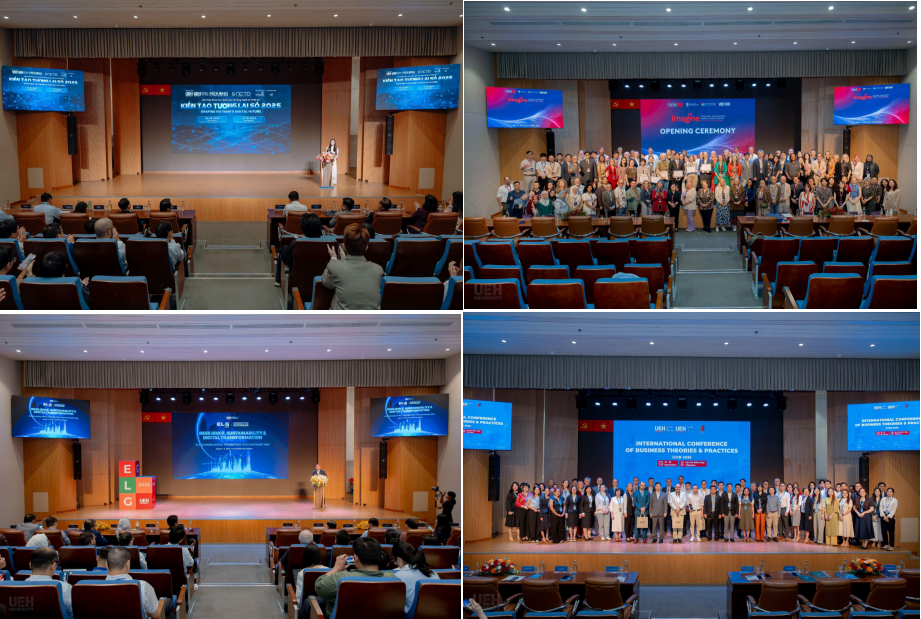
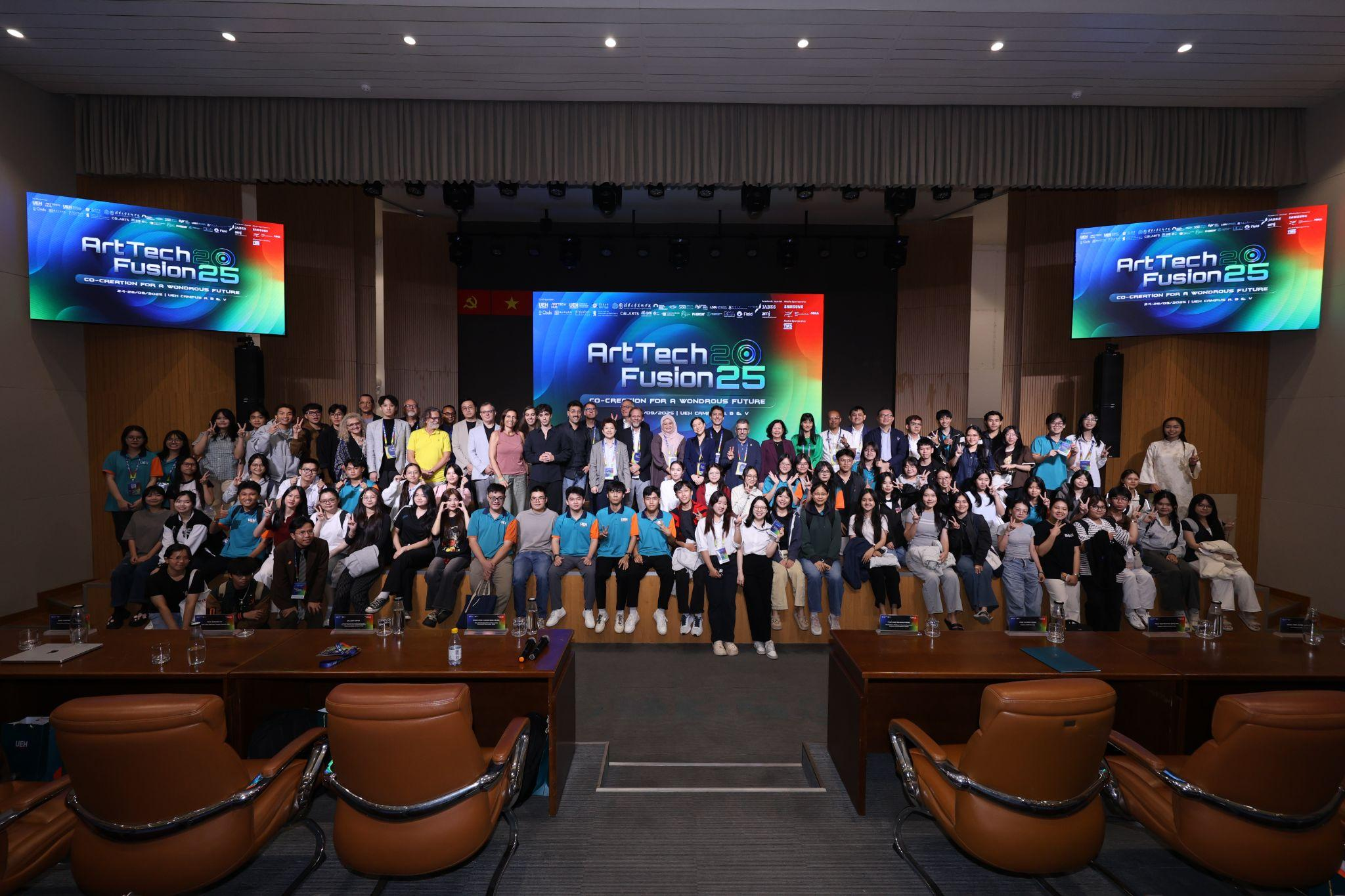
UEH member schools and faculties/institutes successfully organized numerous international-scale conferences
These conferences have provided valuable opportunities for UEH scholars to meet and exchange ideas with international colleagues, expand inter-institutional and inter-regional collaboration, and further affirm UEH’s role as a hub of knowledge where innovative ideas are actively shared and widely disseminated. This also represents a strategic step aligned with UEH’s objectives in the new phase of development: linking research with practice and fostering interdisciplinary academic dialogue in support of sustainable development.
Research aligned with Sustainable Development Goals (SDGs)
Sustainable development has become a guiding principle in UEH’s research strategy in recent years, and 2025 continued to witness growth in research topics and projects aligned with the SDGs - ranging from poverty alleviation and quality education to climate action.
In 2025, more than half of UEH’s international publications were aligned with the Sustainable Development Goals (SDGs), demonstrating an increasingly evident “greening” orientation in its research agenda. Particularly prominent were studies related to decent work and economic growth (SDG 8), industry, innovation and infrastructure (SDG 9), and reduced inequalities (SDG 10), with nearly 600 international publications produced over the past three years. Notably, UEH’s SDG-related publications achieved Field-Weighted Citation Impact (FWCI) scores higher than the global average; several thematic clusters recorded FWCI levels twice the world benchmark, while in SDG 3 (Good Health and Well-Being), SDG 7 (Affordable and Clean Energy), and SDG 13 (Climate Action), this figure reached up to five times the global average, reflecting the outstanding quality and scientific impact of UEH’s research.
At the same time, UEH actively encourages student engagement in SDG-related research through its student scientific research movement. In the 2024–2025 academic year, the UEH Green Campus initiative promoted 151 research projects on sustainable development, of which 73 outstanding studies were edited and widely disseminated. UEH also collaborated with the Ho Chi Minh City Youth Union to organize the “Let’s Green Unitour Day” at 10 universities and colleges, spreading green development thinking across the inter-university student community.
Beyond academic activities, UEH has transformed its campus into a “Living Lab” for sustainable development. The UEH Green Campus model at the Nguyen Van Linh campus (Binh Chanh District) was honoured as a flagship construction project of Ho Chi Minh City, while initiatives such as waste sorting, solar energy adoption, and community gardens have been piloted and scaled up. In 2025, UEH continued to take the lead in implementing the smART Hub Living Labs project, co-creating a net-zero-emissions campus with the goal of making Campus V the first Net-Zero campus. These efforts contributed to UEH being recognized among the Top 50 exemplary organizations in Ho Chi Minh City for contributions to sustainable development.
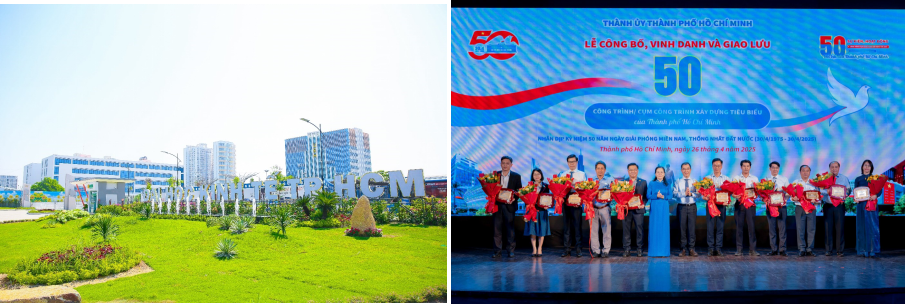
Leaders of the Ho Chi Minh City People’s Committee presented the recognition plaque for the Nguyen Van Linh campus to Prof. Dr. Nguyen Khac Quoc Bao – Vice President of UEH
Knowledge transfer: For sustainable local development
In 2025, alongside its academic achievements, UEH continued to leave a strong mark through community engagement and knowledge transfer activities. Acting as a bridge between the university, local authorities, and the business sector, UEH strengthened policy consultancy and research collaboration in support of regional development. During the year, UEH signed 10 consultancy and knowledge-transfer contracts and conducted 14 policy-review studies commissioned by the Government, ministries, sectors, and local authorities, clearly reflecting its philosophy of “research in service of the community”.
Many ministerial- and provincial-level research projects led by UEH faculty were closely aligned with practical needs. Notable examples include a study on developing a national financial center model in Ho Chi Minh City and a collaborative project with Ben Tre Province on sustainable livelihoods for coastal communities, transferring climate-change adaptation solutions tailored to local conditions. In parallel, UEH organized policy dialogues and workshops in various localities such as Can Tho and Khanh Hoa, creating platforms for exchange among academics, policymakers, and communities, while also gathering feedback to further align research with societal needs.
Applying research outcomes to policy consultancy and policymaking is increasingly becoming a distinctive strength of UEH. In 2025, UEH continued to publish in-depth reports such as the Ho Chi Minh City Macroeconomic Report and policy recommendations on the carbon market, while also initiating the program “Accompanying the Four Pillar Resolutions of the Politburo”, focusing on research solutions related to science and technology, innovation, and national digital transformation. Through these efforts, UEH has further affirmed its role as a hub for knowledge creation and policy development in service of national growth.
At the same time, the academic branding program UEH Research Contribution For All continued to promote the dissemination of research knowledge to the wider community. More than 150 multidisciplinary scientific works and applied knowledge outputs were shared through podcasts and accessible articles, helping to bridge academic research with real-world social impact and bringing to life UEH’s vision of a multidisciplinary, action-oriented, and sustainably engaged university.

Steady steps toward 2026 – Continuing to shape the academic future
The outstanding achievements of 2025 not only conclude a milestone-filled chapter in nearly 50 years of UEH’s development but also lay a solid foundation for the University to confidently enter a new phase. The year 2026 marks a particularly pivotal moment, as it both commemorates UEH’s 50th anniversary and signals the official implementation of its Development Strategy for the 2025–2030 period.
Building on its research achievements and academic contributions, UEH continues to affirm its standing as a multidisciplinary, research-oriented university committed to sustainable action, while expanding its role in community, local, and national development. The spirit of research for the public good will remain a guiding principle, inspiring UEH faculty, researchers, and learners to generate knowledge with lasting value and long-term impact.
With the aspiration of becoming one of the Top 100 universities in Asia by 2045, UEH remains steadfast in its mission to serve society through knowledge, expanding its academic influence not only in economics but also across interdisciplinary fields. With growing confidence and a strong sense of social responsibility, UEH will continue its journey of creating academic value, spreading the light of knowledge, and affirming its pioneering position within Vietnam’s and the region’s higher education landscape.
Pillars: Research, Community
Project: UEH Connecting
News, photos: Department of Research - Development and Global Engagement
![[UEH 50 Global Partners] UEH Promotes Strategic Partnership with Rennes University (France) in Developing Double Degree Programs and International Academic Networks](uploads/thumb_6a9f846b43c42.png)